Exploring the Key Components of SEM
 ROAR |
2 October, 2023 |
7 minute read |
Blog, Search Engine Marketing
ROAR |
2 October, 2023 |
7 minute read |
Blog, Search Engine Marketing

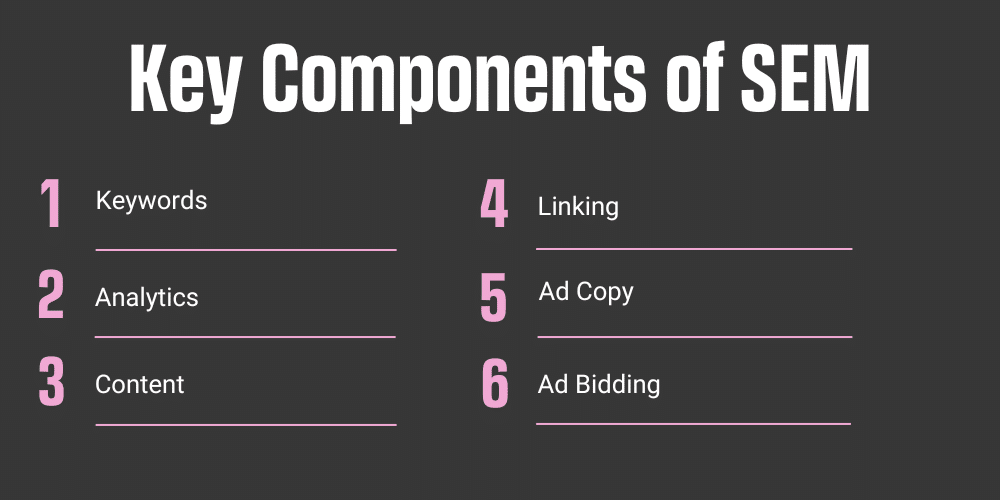
With so many areas of digital marketing, knowing which components fall into which category is always challenging. So, let’s run through 6 key components of SEM and clear up any confusion, figuring out what is SEM in digital marketing.
Why SEM?
Search engine marketing (SEM) is about making sure your business shows up when your ideal customers are actively searching for what you offer.
If you have a website and want people to find you before they find your competitors, SEM plays a crucial role. It helps put your brand in front of the right audience at the right time, when intent is highest.
SEM is made up of two closely connected channels: SEO (search engine optimisation) and PPC (pay-per-click advertising). SEO builds long-term visibility and trust in organic search results, while PPC allows you to appear at the top of search results immediately. When used together, they create a strong, consistent presence that drives sustainable growth.
6 Key Components of SEM
Some key components of SEM are covered in both channels. Other components are specific to each. There are strategies for a killer SEM campaign that gets results.
Keywords
Keywords are the backbone of any SEM campaign, whether it’s paid or organic. They may hold the same level of importance, but the metrics you look at differ ever so slightly.
Organic – You should look at your organic keywords’ volume, intent, and keyword difficulty. This way, you know how many people are searching for that keyword. You also know what they’re looking for and how hard it will be for your content to rank.
Paid – Volume is still vital, as is the intent for your paid search campaigns. The difference comes with cost per click (CPC) and competitive density. This gives you the average cost advertisers pay per click on ads for that keyword. And the competition from other advertisers on that keyword within PCC campaigns.
Analytics
It’s no secret that analytics are one of the most crucial components of SEM campaigns. But knowing what to look for per campaign is the hard part.
For paid advertising campaigns, analytics are usually available directly within the ad platforms. These insights help you track performance through metrics such as cost per click (CPC), cost per acquisition (CPA), impressions, click-through rate (CTR), and overall return on ad spend. This data allows you to optimise budgets, targeting, and ad messaging in real time.
For organic search and SEO, analytics are measured through your website using tools like Google Analytics. Here, you can track organic traffic, user behaviour, time on site, bounce rate, and conversions from organic search. These insights show how well your content attracts, engages, and converts users over time.
By combining paid and organic analytics, you get a complete view of your SEM performance and the insights needed to make smarter, data-driven decisions.
Content
Content sits at the heart of the organic, SEO-driven side of search engine marketing. In today’s search landscape, simply writing to rank isn’t enough. Your content needs to be built around what your audience is genuinely searching for, while still following SEO best practices.
In the past, keyword-focused content alone could secure top positions in search engine results. However, with Google’s helpful content updates, search engines now prioritise content that is useful, relevant, and written for real people, not algorithms.
When creating your next blog post or website page, start with your customers. Consider their questions, challenges, and intent at each stage of their journey. Then apply SEO best practices to help your content get discovered, without losing clarity or value. This approach not only improves rankings but also drives meaningful engagement and conversions from organic search.
Linking
Linking plays a vital role in the organic, SEO-focused side of search engine marketing. It helps search engines understand how your website is structured, how your content connects, and how trustworthy your site is overall.
There are two main types of linking to consider: internal linking and backlinks. Internal linking refers to pages on your website linking to other relevant pages. This helps search engines crawl your site more effectively and understand the relationship between different pieces of content. It also improves user experience by guiding visitors to useful, related information.
Backlinks are links to your website from external sites. These act as signals of authority and credibility in the eyes of search engines. When it comes to backlinks, quality always outweighs quantity. A small number of relevant, high-quality links can have a far greater impact on your rankings than a large volume of low-quality or spammy links.
When internal links and backlinks are built strategically, they strengthen your organic visibility and support long-term SEO growth.
Ad Copy
Ad copy is exactly what it sounds like: the words and messaging used within your ads to attract attention, earn clicks, and drive action.
No matter which advertising platform you’re using, whether that’s Google Ads, Microsoft Ads, or another paid search channel, strong fundamentals matter. Each platform has its own structure and limits, such as the number of headlines and descriptions you can include. For example, Google Ads allows up to 15 headlines and descriptions, and using these effectively gives the platform more opportunities to match your ads with the right searches.
Your ad copy should always be closely aligned with the campaign you’re running and the keywords you’re targeting. The more relevant and specific your messaging is, the more likely it is to resonate with your audience. By carrying out audience research and understanding user behaviour, you can create ads that speak directly to your ideal customers, improve click-through rates, and drive higher-quality conversions.
Check out our blog post, ‘How to write PPC Ads that get clicks,’ to boost your ad copy.
Ad Bidding
When a user makes a search, all of the ads available for that search term head into an auction. From there, the search engine considers different factors to determine which ads should appear.
Ad bidding and auctions differ from platform to platform but generally rely on your ad quality and bid amount.
Your ad quality or quality score is an estimate from ad platforms about user experience when users see your search ads.
It includes a range of factors: relevant ad text, how likely people are to click your ad and the quality of the experience on your landing page.
The better your ad quality is from the offset, the better your ads will likely perform. This includes securing better ad positions and avoiding wasted ad spend.
When it comes to bidding, platforms often have an automated bidding option set up. This is usually titled “Maximise Clicks” or “Maximum Delivery”. These are hands-off approaches that you can set running and not really think about again. However, they are known to be less effective and results-driven.
The recommended method is setting a maximum CPC (Cost Per Click). This is pretty much exactly as it sounds: you get to set the maximum amount you’ll willingly pay for a click on ads within an ad group, specific keywords or placements.
Whilst every ad platform is different, they’re often transparent with how they run their ad auctions. The more prominent platforms like Google Ads and Microsoft Ads have Ads Help Sites to answer any questions you have, from bidding to copy to creative.
Whether you need organic or paid search engine marketing at ROAR, we have the solution for your business. Check out our services to accelerate your business today!
Whether you need organic or paid search engine marketing at ROAR, we have the solution for your business. Check out our services to accelerate your business today!