The Anatomy of a Successful Search Engine Marketing Campaign
 ROAR |
21 September, 2023 |
5 minute read |
Blog, Digital Marketing, PPC, Search Engine Marketing, SEO
ROAR |
21 September, 2023 |
5 minute read |
Blog, Digital Marketing, PPC, Search Engine Marketing, SEO

In 2023, the organic and paid search combination makes up 80% of all trackable website visits. In this digital age, a successful search engine marketing campaign has become essential for businesses to accelerate online growth.
Traditional marketing has taken the back seat in recent years as more companies across the globe try to leverage the power of search engines to reach their target audience. But how exactly is this done? I hear you ask.
Stick around and read on to find out more!
Before we jump in, are you interested in working with an SEM (search engine marketing) agency? Download our FREE resource and learn how ROAR can maximise visibility for your business.
What Is Search Engine Marketing (SEM)?
Search Engine Marketing is the strategic combination of:
- Search Engine Optimisation (SEO) – earning long-term visibility in organic search results
- Pay-Per-Click Advertising (PPC) – capturing immediate demand through paid listings on platforms like Google Ads
When executed correctly, SEO and PPC work together to:
- Increase total search visibility
- Dominate high-intent keywords
- Reduce reliance on a single traffic source
- Improve lead quality and conversion rates
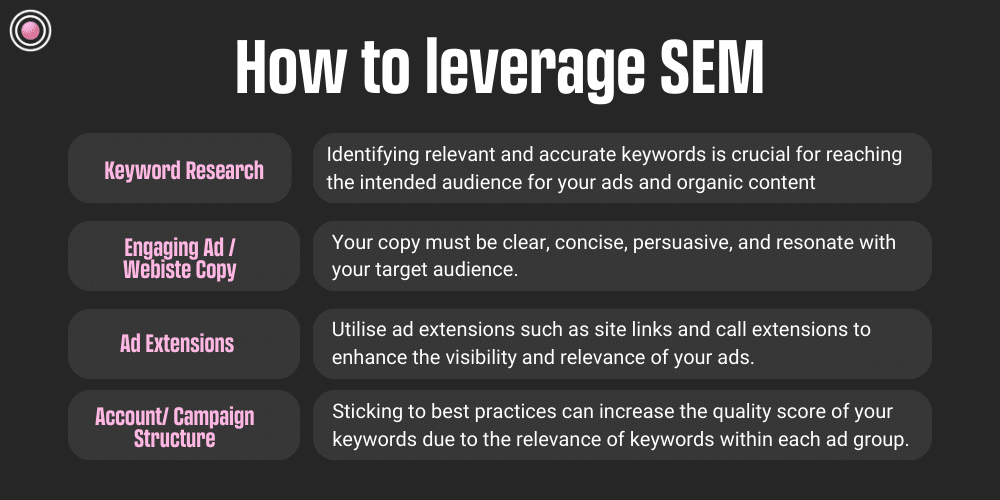
Keyword Research
Keyword research is the single most important part of any search engine marketing strategy because everything else is built on it. Your content, your ads, your landing pages, and even your budget decisions all rely on choosing the right keywords. How could you optimise your website content without relevant keywords or run your pay-per-click (PPC) ads? How could you possibly achieve a successful search engine marketing campaign?
Identifying relevant and accurate keywords is crucial for reaching the intended audience for your ads and organic content.
Focus on a mix of high-volume and long-tail keywords to strike the perfect balance between relevance and reach. Using a keyword research tool such as the SEMrush keyword magic tool will help you find keywords that you may not have thought of. It will provide you with key bits of information such as the keyword volume, CPC (cost-per-click) and competitive density.
Engaging Ad/Website Copy
Once your keyword strategy is in place, it’s time to focus on the words that actually persuade people to take action. Strong ad and website copy is what turns search visibility into clicks, and clicks into customers.
Your messaging should be clear, concise, and easy to understand, but it also needs to connect with your audience on a human level. That means addressing real problems, highlighting real benefits, and making it obvious why your business is the right choice. This is where your unique selling proposition really matters. If you don’t clearly communicate what sets you apart, users have no reason to choose you over a competitor.
A strong call-to-action is just as important. Whether it’s encouraging someone to get in touch, request a quote, or learn more, your CTA should guide the user towards the next step and remove any hesitation about clicking.
Well-written ad copy doesn’t just improve click-through rates, it also sets expectations. When your ads and landing pages align, users are more likely to stay on your site, engage with your content, and ultimately convert. In other words, good copy doesn’t just attract traffic, it attracts the right traffic.
Ad Extensions
Ad extensions give your ads more space and more impact on the search results page. They add useful details like extra links, contact options, or location information, making your ads more visible and more helpful to searchers.
Using extensions such as sitelinks, call extensions, and location extensions increases relevance, improves click-through rates, and gives users more ways to engage with your business before they even reach your website.
Account and Campaign Structure
It might be tempting to throw all your keywords into a single campaign and hope for the best, but that approach rarely ends well. Without a clear structure, budgets get burned quickly, and performance becomes difficult to control or scale.
A well-planned account and campaign structure groups related keywords into tightly themed campaigns and ad groups. This improves relevance between keywords, ads, and landing pages, which in turn helps boost Quality Score. The result is better performance, lower costs, and far more efficient use of your Google Ads budget.
Lastly, remember that SEM is not something you can pick up and drop off whenever it suits you. You must carry out frequent PPC account management to utilise SEM effectively and benefit from the results. This helps eliminate wasted ad spend and carry out A/B testing on your ads, all of which can help generate the highest ROI (return on investment).
To learn more about SEM and how you can implement a strategy that best suits your business, read our blog on ‘Strategies For a Killer SEM Campaign That Gets Results.’
ROAR Digital Marketing offer a specialist suite of search engine marketing services to accelerate your business’s online growth. Check them out here.